


What Is Bespoke Packaging?
Bespoke packaging is made to an agreed specification for a defined application. With flexible packaging, that may be a custom FIBC or bulk bag for powdered ingredients, a woven polypropylene sack for agricultural products, a paper sack for dry goods, a polythene liner for moisture protection, or pallet protection designed for a particular load profile.
The specification begins with the material being packed. Its density, particle size, flow behaviour, moisture sensitivity, contamination risk and hazardous classification all affect the right packaging choice. The way that packaging is filled, moved, stored and emptied matters just as much. A bag used by forklift on a busy construction site needs different features from one discharged through a controlled production line.
Standard packaging remains the right choice for many routine applications. It is readily available, proven and often cost-effective at lower volumes. Bespoke packaging becomes valuable where a standard format creates operational compromise: inefficient filling, product loss, manual handling difficulties, poor pallet utilisation, excess material use or uncertainty around compliance.

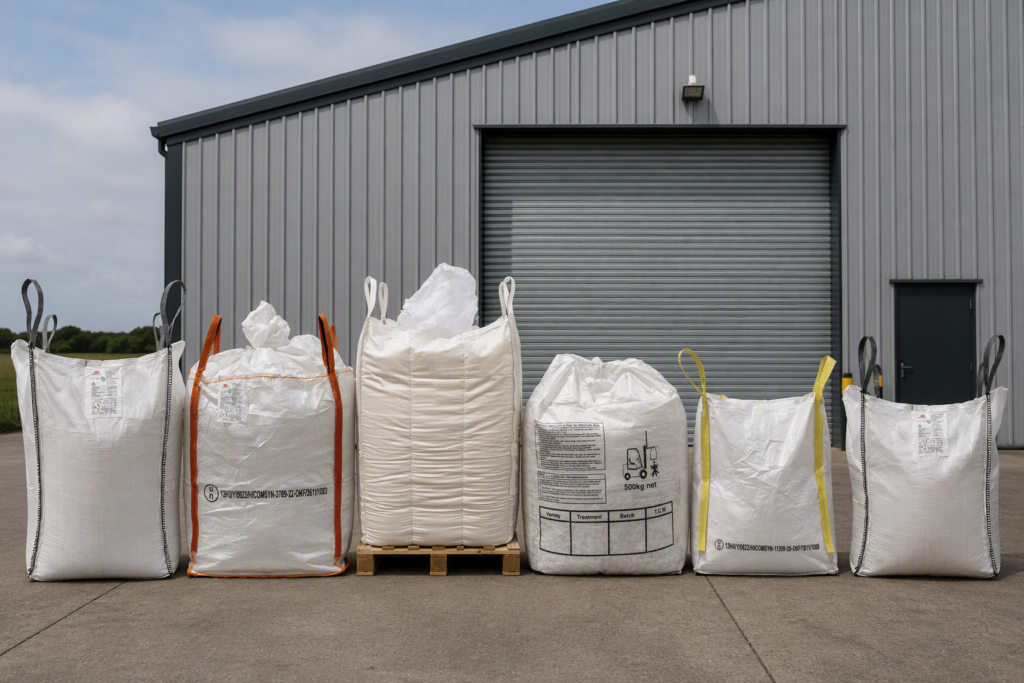
How Bespoke Bulk Bags Are Designed
A bespoke bulk bag is usually built by combining practical design choices that suit the product and site process. Capacity is one of the first considerations, but it is not simply a question of choosing the largest bag possible. The bag’s dimensions must suit the product bulk density, the available headroom, pallet size, filling equipment and safe lifting method.
A lightweight material may require a high-volume bag to achieve the desired weight, while a dense aggregate or mineral product may need a smaller footprint to remain manageable. Safe working load and safety factor must be appropriate to the intended use, particularly where bags are lifted by crane, forklift or other handling equipment.
The filling and discharge arrangement can have a significant effect on productivity. An open-top bag may be suitable for some materials, while a filling spout can help control dust and improve accuracy. At the base, a discharge spout can allow controlled emptying into a hopper or process line. Some applications need a plain base, a protective flap or a closure that prevents leakage during transport.
Lifting loops also need to suit the handling method. Four standard loops may be appropriate for conventional forklift handling, but cross-corner loops, stevedore straps or single-point lifting arrangements can be more suitable in particular environments. The correct design helps operatives position forks safely and reduces the likelihood of damage during loading and unloading.
Materials, liners and coatings
Fabric weight, weave and construction affect strength, containment and the bag’s performance in use. Coated or laminated polypropylene fabric can provide an additional barrier against moisture and fine particles. Uncoated fabric may be suitable where breathability is needed, such as certain agricultural or dry material applications.
An inner liner can provide a higher level of protection where products are moisture-sensitive, fine, free-flowing or vulnerable to contamination. Liners can be fitted, loose or shaped to the bag, depending on the filling and discharge process. However, a liner is not automatically the best answer. It adds material and cost, and a poorly matched liner can slow filling or prevent clean discharge.
Food-grade handling calls for particular care. Buyers should consider the suitability of the bag fabric, liner, manufacturing controls, storage conditions and traceability requirements. For hazardous materials, UN-approved packaging may be required, with the correct certification and use conditions for the product being transported. Static-sensitive products may require a conductive or static-dissipative FIBC design. These are application-specific requirements, not features to assume from a general-purpose bag.
Why Custom Packaging Can Improve Operations
The strongest case for bespoke packaging is usually operational. A correctly sized bulk bag can improve pallet stability and make better use of warehouse space or lorry capacity. A suitable filling spout can reduce dust around the line. A reliable discharge arrangement can limit product remaining in the bag and reduce clean-down time.
Custom packaging can also help reduce material waste. If a standard bag is oversized, over-engineered or requires additional secondary wrapping to perform properly, a better-fitted design may use resources more efficiently. Equally, sustainability should not be treated as a claim based on material alone. The most sustainable option is often the one that protects product effectively, avoids rejected loads and is designed with realistic end-of-life handling in mind.
Recyclability depends on the packaging construction and on what it has contained. A single-material format may be easier to manage through certain recycling streams than a multi-layer construction, but contamination, local facilities and site segregation arrangements still determine what is practical. Where reuse is being considered, the bag’s design, handling history and safety requirements need to be assessed carefully.
There is also a commercial benefit to reducing variation in a process. When packaging fits machinery, pallets and handling procedures consistently, teams spend less time adapting around avoidable problems. That can mean fewer damaged bags, fewer short shipments and more predictable procurement.
The Information Needed for a Bespoke Specification
A useful bespoke packaging brief does not need to start with technical terminology. It needs a clear picture of the application. Product details, target fill weight, loading method, discharge method, pallet dimensions, storage conditions and transport route will provide a strong foundation.
It is also helpful to identify any non-negotiable requirements at the outset. These may include food-contact suitability, UN approval, moisture protection, UV resistance, static control, printed handling instructions or a particular closure format. If the packaging is used outdoors, stored for extended periods or exposed to rough site conditions, that should be part of the conversation rather than an afterthought.
Samples, photographs of the existing process and details of current failures are often especially valuable. A supplier can see whether the issue is a bag construction problem, an unsuitable liner, poor filling practice, incorrect forklift handling or a mismatch between the package and the equipment. Bespoke design works best when it addresses the cause, not just the visible symptom.
When Standard Packaging Is the Better Choice
Custom-made packaging is not always necessary. A standard bulk bag, polypropylene sack, paper sack, pallet wrap roll or sandbag may already meet the requirement, particularly where the product, fill weight and handling method are conventional. Stock formats can offer quicker availability and may be more economical where demand is limited or variable.
The decision should be based on total operating value rather than purchase price alone. If a standard product performs safely and efficiently, there is little reason to complicate procurement. If it causes frequent breakages, lost product, handling delays or additional packing steps, a bespoke alternative may justify its cost through improved performance.
Smartlift Bulk Packaging works with businesses to establish that distinction, matching standard products where appropriate and developing custom flexible packaging where the application demands it.
A Practical Route to Better Packaging
Bespoke packaging should be treated as part of the wider handling system, not a separate purchasing item. The product, people, machinery, warehouse, transport route and compliance obligations all shape the right answer. A bag that looks suitable on a specification sheet may still be wrong if it does not suit the filling head, forklift tines or discharge point.
Before committing to a larger order, review the proposed format against the real process and, where appropriate, trial it under normal working conditions. The right bespoke packaging is the version that allows your operation to pack, move, store and empty material with greater control and fewer compromises.
